Last updated on October 2nd, 2026 at 04:51 am
You’re scrolling through voice notes from your friends. One says, “Bro, that was a total ‘skrrt’ moment!” Another replies with a dramatic “oof” followed by laughter.
Later that evening, someone mimics a “boing” sound after a joke falls flat. No dictionary could fully explain these—but everyone in your circle instantly gets it.
That’s the power of acoustic slang—language shaped by sound rather than strict vocabulary.
Slang isn’t just about words; it’s about belonging. These sound-driven expressions act like social shortcuts, signaling humor, shared culture, and emotional tone in ways plain language can’t. Acoustic slang, in particular, thrives because it taps into something primal: human reactions to sound.
Why does slang evolve? Because people constantly reshape language to reflect identity, trends, and group boundaries. Acoustic slang goes a step further—it turns noise into meaning. A single “ugh,” “bruh,” or “ding” can communicate layers of sarcasm, frustration, or excitement.
In digital culture—where voice notes, memes, and short-form content dominate—sound-based slang has become a badge of identity. It tells others: I’m part of this moment, this culture, this inside joke.
2️⃣ The Psychology & Culture Behind Acoustic Slang
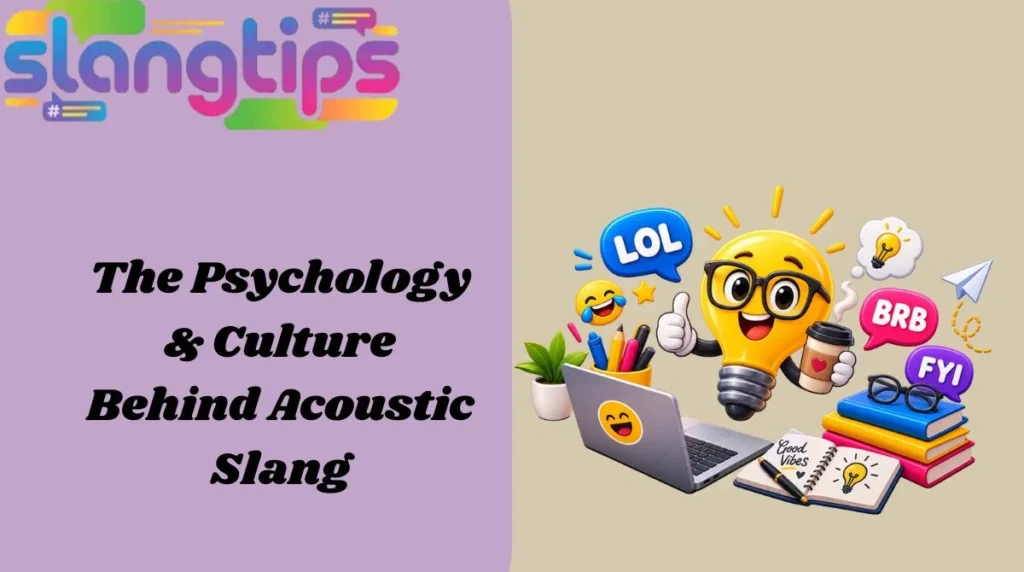
Acoustic slang operates at the intersection of emotion, performance, and social signaling.
Emotional tone
Sound-based slang carries raw emotion more directly than text. A drawn-out “nooooo” expresses despair better than a sentence ever could. The tone—pitch, repetition, exaggeration—becomes meaning itself.
Social meaning
Using acoustic slang signals in-group awareness. If you know when to drop a “skrrt” or “bruh,” you’re culturally fluent. If you don’t, you risk sounding out of touch.
Online culture impact
Platforms driven by audio and short-form content have accelerated this trend. Sound bites, reaction clips, and viral audio loops transform simple noises into widely understood expressions.
Pop culture influence
Music, gaming, and comedy heavily shape acoustic slang. Sound effects from songs, memes, or viral videos quickly become linguistic tools.
Tone signaling
Acoustic slang often conveys:
- Humor (“boing”)
- Sarcasm (“yeahhh right”)
- Rebellion (“nahhh”)
- Bonding (shared inside sounds)
- Dramatic exaggeration (“oof”)
In short, acoustic slang turns communication into performance.
3️⃣ 13 Acoustic Slang (Grouped by Tone)

A. Positive / Praise Slang
1. “Sheeesh”
• Meaning: Expresses strong admiration or hype
• Tone: Excited / Impressed
• Text: “Sheeesh that outfit 🔥”
• Speech: “Sheeesh! You really did that.”
• Formal: That’s very impressive
2. “Ding!”
• Meaning: Something is correct or perfectly timed
• Tone: Playful / Affirming
• Text: “You guessed it—ding!”
• Speech: “Ding! That’s exactly right.”
• Formal: Correct
3. “Vroom”
• Meaning: Fast, energetic, high-performance
• Tone: Energetic
• Text: “This project is going vroom today”
• Speech: “We’re moving vroom now!”
• Formal: Progressing quickly
4. “Ayy”
• Meaning: Celebration or approval
• Tone: Friendly / Celebratory
• Text: “Ayy you made it!”
• Speech: “Ayy! Good to see you.”
• Formal: Glad to see you
B. Funny / Playful Slang
5. “Oof”
• Meaning: Reaction to awkwardness or mild pain
• Tone: Sympathetic / Humorous
• Text: “Oof that must’ve hurt”
• Speech: “Oof, that’s rough.”
• Formal: That is unfortunate
6. “Boing”
• Meaning: Something silly, unexpected, or bouncing back
• Tone: Goofy
• Text: “My motivation just went boing 😂”
• Speech: “And then—boing—it failed.”
• Formal: It changed suddenly
7. “Bruh”
• Meaning: Disbelief or mild frustration
• Tone: Casual / Playful
• Text: “Bruh what was that”
• Speech: “Bruh… seriously?”
• Formal: That is surprising
8. “Skrrt”
• Meaning: Abrupt stop or change of direction
• Tone: Playful / Dramatic
• Text: “I was going out—skrrt—plans canceled”
• Speech: “I was leaving, then skrrt—I stayed.”
• Formal: Suddenly changed plans
9. “Yikes”
• Meaning: Cringe or mild shock
• Tone: Lightly negative / Humorous
• Text: “Yikes that’s embarrassing”
• Speech: “Yikes… that didn’t go well.”
• Formal: That is awkward
C. Negative / Insult Slang
10. “Ugh”
• Meaning: Annoyance or disgust
• Tone: Irritated
• Text: “Ugh I can’t deal with this”
• Speech: “Ugh, not again.”
• Formal: This is frustrating
11. “Nahhh”
• Meaning: Strong rejection or disbelief
• Tone: Dismissive
• Text: “Nahhh that’s not happening”
• Speech: “Nahhh, I don’t agree.”
• Formal: I disagree
12. “Huh?”
• Meaning: Confusion or disbelief
• Tone: Questioning / Skeptical
• Text: “Huh? What do you mean?”
• Speech: “Huh? Say that again.”
• Formal: Could you clarify?
13. “Tsk”
• Meaning: Disapproval or disappointment
• Tone: Critical
• Text: “Tsk… bad decision”
• Speech: “Tsk, that wasn’t wise.”
• Formal: That was inappropriate
4️⃣ Slang Lifespan: From Viral to Vintage
Slang doesn’t last forever—it moves in cycles.
How trends rise
- Viral content spreads a sound
- Influencers normalize it
- Communities adopt it rapidly
Why slang fades
- Overuse kills originality
- Older generations adopt it
- New trends replace it
Evergreen vs Trend Slang
- Evergreen: “ugh,” “huh,” “ayy” (timeless emotional sounds)
- Trend-based: “skrrt,” “sheeesh” (tied to specific cultural waves)
Warning sign of outdated slang
If it feels forced or overexplained—it’s probably already fading.
6️⃣ Build Your Own Acoustic Slang
Creating slang is easier than you think. It follows patterns:
1. Word shortening
Turn “seriously” → “srsly” → eventually just tone-based sounds
2. Sound play
Stretch vowels: “no” → “noooo”
3. Cultural reference
Borrow from music, memes, or games
4. Irony twist
Use a dramatic sound for minor situations
5 Creative Examples
- “Plink” → something small but satisfying
- “Zoop” → something disappearing quickly
- “Grmm” → low-key annoyance
- “Tadaaa” → exaggerated reveal
- “Blip” → minor mistake
7️⃣ Interactive Practice Lab
Fill in the blanks
- That fall looked painful… ___
- You got the answer right—___!
- ___… I don’t believe that story
- That joke was so bad—___
- Plans canceled last minute—___
- Your outfit today—___!
- I’m confused… ___?
- That was embarrassing—___
- Stop right there—___
- This again? ___
Context Identification
- Which slang shows admiration?
- Which one signals confusion?
- Which expresses sudden change?
- Which shows mild disappointment?
- Which is playful exaggeration?
Is This Appropriate?
- Using “bruh” in a job interview
- Saying “ugh” in a formal email
- Using “sheeesh” with close friends
- Saying “tsk” to your boss
- Using “yikes” in academic writing
8️⃣ FAQs
What is acoustic slang?
It’s slang based on sounds, vocal reactions, or audio expressions rather than traditional words.
Why is acoustic slang popular?
Because it conveys emotion quickly and fits perfectly with voice notes, memes, and short-form content.
Is acoustic slang universal?
Partially—basic sounds like “ugh” exist globally, but meanings vary by culture.
Can acoustic slang become formal language?
Rarely, but some expressions eventually enter mainstream dictionaries.
Is using slang unprofessional?
In formal contexts, yes. It’s best reserved for casual or social communication.
How do I keep up with new slang?
Stay engaged with online culture, but use selectively to avoid sounding forced.
9️⃣ Conclusion
Acoustic slang shows that language isn’t just about words—it’s about experience. These sound-based expressions capture emotion, humor, and identity in their rawest form.
As culture evolves, so does the way we communicate, shifting from structured sentences to expressive bursts of sound.
In a world driven by fast communication and digital interaction, acoustic slang isn’t just a trend—it’s a reflection of how humans adapt language to stay connected, creative, and culturally relevant.

Mason Reed is a passionate writer who simplifies modern slang and trending expressions to make everyday communication easy and fun.